Mycelium Leather Advances Toward Commercial Use in Fashion
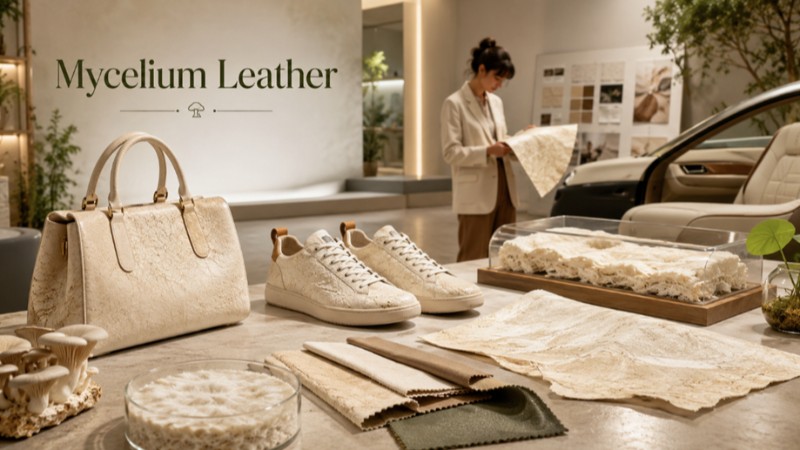
Mycelium leather — a bio-based material grown from fungal root structures known as mycelium — continues attracting attention across the global fashion and textile industry as brands search for alternatives to animal leather and petroleum-based synthetics.
Although large-scale commercialization remains challenging, 2026 has seen continued investment and experimentation in mycelium-based materials for luxury fashion, footwear, accessories, and automotive interiors. The technology is increasingly being viewed not as a short-term sustainability trend, but as part of a broader transition toward next-generation biomaterials.
What Is Mycelium Leather?
Mycelium is the underground root-like network of fungi. Under controlled growing conditions, these microscopic fungal fibers can form dense interconnected structures that resemble leather-like sheets after processing and finishing.
Unlike traditional leather production, mycelium materials can be cultivated in days rather than requiring years of livestock farming. Developers also claim the process may reduce land use, water consumption, and dependence on animal-derived materials.
Most mycelium leather materials are not entirely plastic-free, however. Many current commercial versions still require coatings, binders, or textile backings to improve durability, flexibility, and water resistance.
This distinction has become increasingly important as the industry moves beyond marketing claims toward more detailed scrutiny of material composition and scalability.
Luxury Fashion Brands Continue Exploring Mycelium Materials
One of the most widely recognized mycelium leather projects has been Mylo™, developed by US biomaterials company Bolt Threads.
The material gained international attention after partnerships with major brands including Stella McCartney, Adidas, Lululemon, and Kering. Stella McCartney previously showcased garments and accessories made with Mylo as part of its ongoing push toward alternative materials.
According to Stella McCartney, the company continues investing in lower-impact material alternatives as part of its broader sustainability strategy.
Luxury group Hermès has also experimented with mushroom-based leather alternatives through a partnership with California startup MycoWorks. The collaboration attracted significant industry attention because it signaled that high-end luxury brands were beginning to evaluate biomaterials not only for sustainability positioning, but also for premium craftsmanship applications.
MycoWorks' Fine Mycelium™ technology focuses heavily on material consistency, grain control, and luxury-level surface quality — areas traditionally difficult for alternative leather materials to achieve.
The Industry Is Shifting From Concept to Scalability
While early media coverage around mycelium leather focused heavily on sustainability narratives, industry discussion in 2026 is increasingly centered on scalability, manufacturing economics, and performance consistency.
One of the biggest challenges facing mycelium materials is industrial production capacity. Scaling biomaterial manufacturing while maintaining consistent texture, strength, color stability, and finishing quality remains technically difficult.
Several early-stage biomaterial startups have also faced financial pressure as investment markets become more selective. Bolt Threads, for example, paused large-scale Mylo commercialization efforts in 2023 despite strong brand visibility, highlighting the economic complexity of scaling next-generation materials.
At the same time, newer companies continue expanding production capabilities.
MycoWorks recently increased focus on commercial manufacturing infrastructure, while Indonesian biomaterial company MYCL has continued developing mycelium materials derived from agricultural waste streams for regional manufacturing applications.
The shift suggests the industry is gradually moving from experimental prototypes toward more specialized commercial use cases.
Beyond Fashion: Automotive and Interior Applications Expand
Another major development is the growing interest in mycelium materials outside traditional fashion categories.
Automotive suppliers, furniture manufacturers, and interior material developers are increasingly exploring fungal biomaterials as potential alternatives to synthetic upholstery and coated leather products.
Compared with apparel, interior applications may offer advantages because they often prioritize surface appearance, sustainability positioning, and material innovation over extreme flexibility or wash durability.
As a result, some analysts believe automotive interiors and premium upholstery could become important early commercial markets for mycelium-based materials.
Biomaterials Are Becoming a Strategic Textile Innovation Category
The growing interest in mycelium leather reflects a wider transformation happening across the textile and materials industry.
Brands are facing increasing pressure from:
· carbon reduction targets
· animal welfare concerns
· PFAS and chemical regulations
· consumer demand for bio-based materials
· circular economy policies
This has accelerated investment not only in mycelium materials, but also in pineapple leaf fibers, bacterial cellulose, algae-based textiles, and agricultural waste-derived biomaterials.
However, industry experts increasingly caution that sustainability claims alone are no longer enough. Commercial success will depend on whether next-generation biomaterials can achieve the performance, consistency, scalability, and cost structure required by global supply chains.
For now, mycelium leather remains an emerging material category rather than a mass-market replacement for conventional leather. But continued investment from luxury brands, biomaterial startups, and manufacturing groups suggests fungal-based textiles are likely to remain one of the textile industry's most closely watched innovation areas in the coming years.