Sweat-Masking Fabrics Are Emerging as a New Direction in Performance Textiles
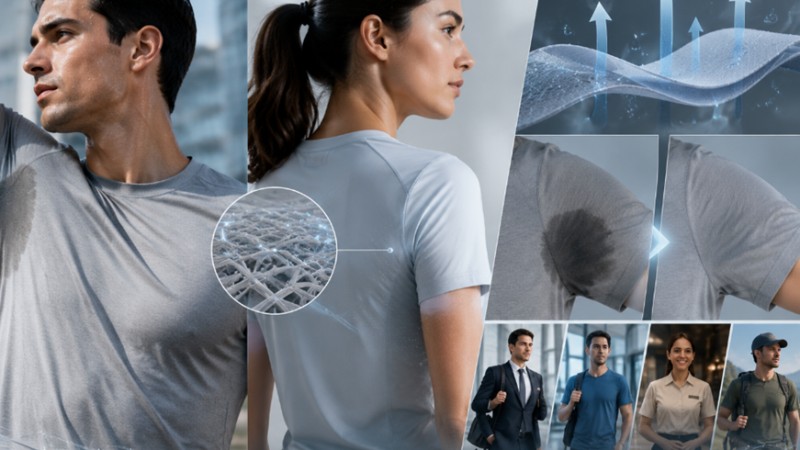
For decades, performance apparel innovation has focused on moisture-wicking, breathability, and quick-drying technologies. In 2026, a new concept is beginning to attract attention across the textile industry: sweat-masking fabrics.
Rather than simply moving moisture away from the skin, these materials are designed to reduce the visible appearance of sweat marks on clothing. The goal is straightforward but highly relevant—help wearers stay comfortable and confident in situations where visible perspiration can become a social or professional concern.
As performance textiles continue evolving beyond athletic applications, experts see sweat-masking technology as a new frontier in everyday apparel innovation.
Why Visible Sweat Remains a Consumer Problem
Traditional moisture-wicking fabrics help transport sweat away from the body, but they do not necessarily prevent dark sweat patches from appearing on garments.
This is particularly noticeable on light gray, pastel, and mid-tone colored fabrics. Even when a garment dries quickly, temporary discoloration can create visible sweat marks under the arms, on the back, or around the chest.
For many consumers, the issue is not physical comfort but appearance.
As workwear, commuting apparel, and active lifestyles increasingly overlap, brands are paying more attention to what industry experts call "visual comfort"—how clothing looks while being worn throughout the day.
How Sweat-Masking Fabrics Work
The latest sweat-masking technologies do not rely solely on moisture management. Instead, they combine fiber engineering, fabric construction, and optical design principles.
One of the most widely discussed examples is COOLMAX® CloakFX™, introduced globally by The LYCRA Company in 2026. According to the company, the fiber is engineered to reduce the visual contrast between dry and wet areas of a fabric, helping minimize the appearance of sweat marks.
The concept is based on light interaction. When conventional fabrics become wet, changes in light absorption and reflection often make the affected area appear darker. Sweat-masking fibers are designed to alter how light interacts with the fabric surface, reducing this visual difference.
In simple terms, the fabric may still absorb moisture, but the sweat becomes less noticeable.
This represents a significant shift from traditional performance textile development, where moisture transport was typically the primary objective.
Potential Applications Extend Beyond Sportswear
Although the technology originates from the performance apparel sector, industry observers believe its commercial potential reaches much further.
Business-casual apparel is an obvious opportunity. Office workers, sales professionals, and commuters often experience perspiration during travel or long working days but may not require highly technical sportswear.
Uniforms represent another promising category. Hospitality staff, retail associates, healthcare workers, and airline employees frequently work in environments where appearance matters but physical activity remains unavoidable.
The technology may also find applications in golf apparel, travel clothing, outdoor lifestyle products, and premium athleisure collections.
In each case, the value proposition is similar: maintaining a cleaner appearance throughout the day without sacrificing comfort.
The Rise of "Visual Performance" Textiles
The emergence of sweat-masking fabrics reflects a broader trend in textile innovation.
Historically, functional fabrics were evaluated using metrics such as moisture management, thermal regulation, stretch, or abrasion resistance. Increasingly, brands are exploring technologies that influence how garments look as well as how they perform.
Examples include anti-shine fabrics, wrinkle-resistant materials, anti-see-through constructions, and color-adaptive textiles. Sweat-masking technology fits naturally into this category of "visual performance" innovations.
Rather than improving athletic output, these materials enhance the everyday wearing experience.
What Comes Next?
The commercial success of sweat-masking fabrics will ultimately depend on cost, durability, and consumer acceptance. Like many textile innovations, the challenge is scaling production while maintaining consistent performance across different colors, fiber blends, and fabric constructions.
However, the underlying idea addresses a genuine consumer need that traditional moisture-wicking fabrics have not fully solved.
As performance apparel increasingly merges with workwear, travel apparel, and everyday clothing, technologies that improve both physical and visual comfort are likely to attract growing attention.
For textile manufacturers, the next generation of functional fabrics may not simply move sweat better—it may make sweat less visible altogether.