Plant-Based Textile Fibers Expand Beyond Bamboo and Hemp
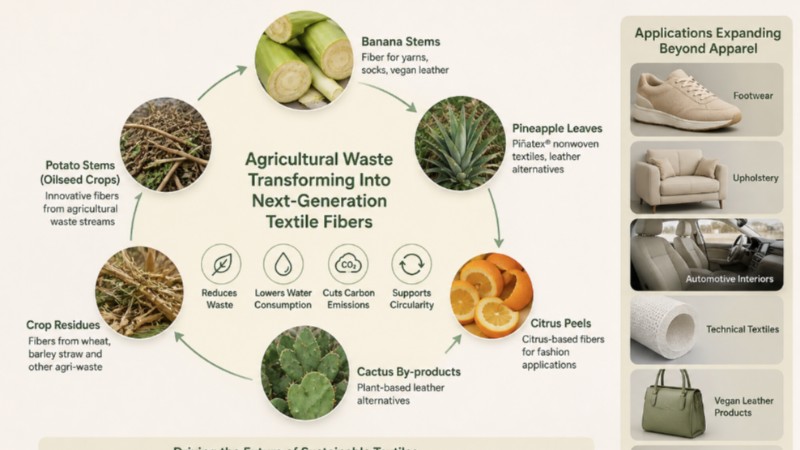
The textile industry is rapidly expanding its focus beyond traditional plant-based materials such as bamboo and hemp. In 2026, a growing wave of innovation is transforming agricultural waste — including banana stems, pineapple leaves, citrus peels, cactus by-products, and crop residues — into next-generation textile fibers and bio-based materials.
The shift reflects broader industry pressure to reduce dependence on petroleum-based synthetics while addressing textile waste, carbon emissions, and resource consumption. As brands and manufacturers search for scalable alternatives, agricultural by-products are increasingly viewed as a viable raw material source for future textile production.
Agricultural Waste Emerges as a New Fiber Source
One of the strongest trends in textile materials this year is the use of agricultural residues that were previously discarded or burned after harvest.
London-based startup Fibe, recently named a finalist in the 2026 Global Fashion Agenda Trailblazer Award, is developing textile fibers from agricultural waste streams instead of conventional cotton. The company originally experimented with potato stems and is now adapting its technology to local agricultural waste sources such as oilseed crops and banana waste.
According to the company, the long-term goal is not to replace cotton entirely with a single universal fiber, but to create multiple fiber formulations tailored for different textile applications.
This reflects a wider industry realization:
future sustainable fibers may come from regionally available agricultural waste rather than globally standardized raw materials.
Banana Fiber Gains Attention in Asia's Textile Sector
Banana fiber has become one of the most discussed emerging plant-based textile materials in Asia.
Reuters recently reported that Taiwan-based company Farm to Material is converting discarded banana pseudostems into textile fibers for yarns, socks, and vegan leather applications.
The banana plant's central stem is normally left in the field after harvest. Instead of treating it as waste, manufacturers are extracting cellulose fibers that offer promising absorbency and lower water consumption compared with conventional cotton.
Charlotte Chiang of the Taiwan Textile Federation noted that banana fiber may outperform regular cotton in areas such as water efficiency and absorbency.
This is particularly significant because water consumption remains one of the textile industry's largest sustainability challenges.
Pineapple and Citrus Waste Continue Moving Into Commercial Textiles
Pineapple leaf fiber is also gaining renewed attention through materials such as Piñatex, which converts agricultural waste from pineapple farming into nonwoven textile materials and leather alternatives.
According to Piñatex developer Ananas Anam, the pineapple industry generates approximately 40,000 tonnes of leaf waste annually, much of which is traditionally discarded or burned.
Meanwhile, citrus-based textile materials are becoming more visible in premium fashion applications. Italian material innovators have continued developing orange-fiber textiles derived from citrus juice by-products.
These materials are part of a broader movement toward:
• waste-to-textile systems
• circular bioeconomy models
• regenerative material sourcing
The Industry Is Moving Beyond “Eco-Friendly” Marketing
While plant-based fibers are often associated with sustainability claims, industry focus is increasingly shifting toward scalability, performance, and infrastructure compatibility.
This marks an important change.
Earlier generations of sustainable textile innovation often struggled because materials performed well environmentally but failed commercially due to:
• inconsistent fiber quality
• limited durability
• weak supply scalability
• incompatibility with existing textile machinery
Today's textile startups are focusing much more heavily on industrial feasibility.
For example, Finnish material company Spinnova is developing textile fiber technology that converts wood pulp and agricultural waste into fibers without chemical dissolution processes traditionally used in regenerated cellulose production.
The company has also expanded research into agricultural by-products such as wheat and barley straw.
This indicates that future textile innovation may increasingly depend on technologies capable of integrating waste materials into existing textile manufacturing systems.
Plant-Based Textile Fibers Are Expanding Beyond Apparel
Another important development is that bio-based fibers are no longer limited to fashion garments alone.
Plant-derived textile materials are now appearing in:
• footwear
• upholstery
• automotive interiors
• technical textiles
• vegan leather products
• packaging materials
Cactus-based leather alternatives, pineapple fiber composites, and mycelium-derived materials are all attracting attention from both fashion and industrial product manufacturers.
This diversification is important because it reduces dependence on a single market category and improves the commercial viability of emerging materials.
Material Innovation Is Becoming a Strategic Industry Priority
The rise of agricultural waste fibers also reflects broader structural changes inside the global textile industry.
Brands are now under increasing pressure from:
• PFAS regulations
• carbon reduction targets
• extended producer responsibility rules
• consumer demand for lower-impact materials
As a result, textile material innovation is moving from a niche sustainability initiative toward a core business strategy.
The next generation of plant-based fibers is unlikely to replace polyester or cotton overnight. However, the growing investment in agricultural waste textiles suggests that future material sourcing will become more diversified, localized, and circular.
For textile manufacturers, sourcing teams, and material developers, the key question is no longer whether alternative plant-based fibers will expand — but which materials can scale fast enough to become commercially viable.